文献阅读规划(12篇)
这一组决定你对”多智能体””MDT””综述定位”的基本理解。读的时候不要追求记住每个细节,要追求”能用自己的话讲清楚一个完整故事”。
目录
| # | 文献(按参考编号) | 论文原名称 | 对应综述章节 | 要学到的核心内容 | 流程图 |
|---|---|---|---|---|---|
| 1 | 44. Konzmann et al. (2026) LLM in tumor boards: systematic review | Applications of large language models in tumor boards: a systematic review | 引言、4.3 | 现有 MDT+LLM 综述怎么定义范围、怎么组织证据、结论是什么;这是你的”锚点综述” | |
| 2 | 33. Guo et al. (2024) LLM-based multi-agents survey | Large language model based multi-agents: a survey of progress and challenges | 3.1、3.2 | LLM 智能体的定义(工具、RAG、记忆、规划、反思);多智能体的通用分类 | |
| 3✅ | 54. Li, X. et al. (2024) LLM-based MAS: workflow, infrastructure, challenges | A survey on LLM-based multi-agent systems: workflow, infrastructure, and challenges | 3.1、4.5 | 多智能体从工作流、基础设施、挑战三个角度的全景框架 | 认识 Agent 的零件:agent可以被分类成什么?(定义) |
| 4✅ | 96. Yao et al. (2026) AI hospitals survey | LLM-based multi-agent systems for clinical workflows: a survey of AI hospitals | 3.1、3.3、3.5 | 医疗多智能体如何组织临床工作流;AI 医院类模拟环境如何评测 | 提出 AI hospital概念:将AI医院定义为工作流级临床系统(流程落地) |
| 5✅⭐ | 92. Xiong et al. (2026) MAS for medicine: accountable orchestration | Not just one agent: LLM-based multi-agent systems for medicine from answer generation to accountable workflow orchestration | 3.1、4.1 | 医疗多智能体从”生成答案”到”工作流编排”的演变;可问责性 | 把医学 MAS 从“能跑医院流程”推进到“能被审计、被追责、被治理”。(落地审查) |
| 6✅ | 84. Tang et al. (2024) MedAgents | MedAgents: large language models as collaborators for zero-shot medical reasoning | 3.2.1、3.4 | 最早的医疗多智能体框架之一:角色化、协作讨论、零样本推理 | 医疗多智能体框架(早期agent落地) |
| 7✅(实现代码) | 43. Kim et al. (2024) MDAgents | MDAgents: an adaptive collaboration of LLMs for medical decision-making | 3.2.1、3.2.3、3.4 | 自适应协作:根据任务难度选择独诊/团队;这是”协作+层级”的交界 | 自适应协作解决了什么问题?它和固定团队的区别? |
| 8 | 13/15. Chen, K. et al. MDTeamGPT (2025/2026) | MDTeamGPT: a self-evolving LLM-based multi-agent framework for multi-disciplinary team medical consultation;MDTeamGPT: mitigating context collapse and enabling self-evolution in medical multi-agent reasoning | 3.2.4、3.4、3.6.2 | 共识聚合+残余讨论+知识库;”上下文崩塌”问题 | 上下文崩塌是什么?系统怎么缓解? |
| 9 | 58. Liu, Q. et al. (2026) EvoMDT | EvoMDT: a self-evolving multi-agent system for structured clinical decision-making in multi-cancer | 3.2.4、3.4、4.2 | 自进化 MDT 系统:根据专家反馈和结局信号更新提示词、权重、检索范围 | 自进化在 MDT 中如何实现?它和普通多智能体的差异? |
| 10 | 85. Vasilev et al. (2025) MTBBench | MTBBench: a multimodal sequential clinical decision-making benchmark in oncology | 3.5、4.4 | 肿瘤会诊专用基准:多模态、纵向、证据调和 | MTBBench 为什么比通用基准更适合 MDT?它测出了什么失败? |
| 11 | 104. Zhu, Y. et al. (2025) MedAgentAudit | Auditing medical multi-agent AI reveals risks of false consensus | 3.2.2、3.6.1、4.5 | 审计多智能体执行日志;虚假一致、沉默同意、未激活专科推理 | 审计发现了哪几类协作失败?为什么”辩论”不一定可靠? |
| 12 | 27. Gallifant et al. (2025) TRIPOD-LLM | The TRIPOD-LLM reporting guideline for studies using large language models | 3.6.4、4.5 | LLM 研究报告的最低报告要求 | TRIPOD-LLM 有几个条目?它如何支撑你综述的”评测不足”论点? |
本博客所有文章除特别声明外,均采用 CC BY-NC-SA 4.0 许可协议。转载请注明来源 ctyyy的博客!
相关推荐

2026-08-16
LLM-based multi-agent systems for clinical workflows: a survey of AI hospitals
论文框架论文提出了人工智能医院(AI hospital)的概念: 人工智能医院指工作流程级的多智能体临床模拟或部署,具有明确的角色、跨交接的共享状态、基于证据的工具、安全门和纵向跟踪。这是”像医院一样运转”的最低条件。一个系统可以只做会诊、分诊、出院、医学教育或心理健康随访,但只有当它的行动被组织为”跨角色、跨阶段、有持久上下文、有明确问责、有可审计日志”的流程时,才算进入 AI hospital 的范围。 步骤 干什么 Triage(分诊) 判断紧急程度,收集第一份结构化信号,例如急危重症等级、红旗警示、初步证据链接 Consult(会诊) 更新初步诊断,把证据链接到建议的行动,并明确还需要澄清什么 Discharge(出院) 把当前方案转化成患者指导、随访计划和升级标准 不同于医疗保健聊天机器人,这里的重点是明确的状态和切换、操作感知评估,以及作为分阶段协议而不是松散声明的部署准备情况。 普通的医疗保健机器人 关注”模型能不能答对问题”; 每个回答、每轮对话基本独立,答完就算完; 评测以最终答案的准确率、F1、人工评分为主; 说”可以部署”往往只靠一...

2026-08-16
Not just one agent: LLM-based multi-agent systems for medicine from answer generation to accountable workflow orchestration
摘要医学 MAS 不应作为更大的 LLM 工作流来评估,而应作为临床协调基础设施,在人工与智能体团队之间重新分配证据、责任和风险。 论文提出的 MDT 风格 MAS 运行流程: 评估系统和临床验证标准基本框架 左侧总结了结果级、过程级和部署级的评估维度;右侧重点介绍了比较性和高级验证方法,以及鲁棒性、效率和代表性基准数据集和任务。 评估指标 结局层:对医学 MAS 的评估首先要保留基本结果级指标,如诊断准确率、召回率、F1 分数、top-k 命中率、治疗建议一致性以及指南一致性。这些指标能说明系统结论是否具有临床可接受性,但解释不了这些结论是如何形成的。 过程层:对 MAS 来说,更关键的问题是协作过程本身是否可靠,包括任务路由是否恰当、智能体之间的信息交接是否完整、外部工具使用是否正确、证据来源是否清晰,以及在多轮协作后结论是否缺乏正当理由地漂移。 部署层:从”跑分好看”到”能不能进真实医院”,即临床可执行性。看输出能否被真实临床执行:比如医嘱集不只是判对错,而是让医生按 accuracy / usefulness / feasibility /...

2026-08-16
MedAgents: large language models as collaborators for zero-shot medical reasoning
MedAgents的五阶段流程图 方法⭐这个方法全程自动,从input到output全程不需要人 q = 题目(question) op = 一堆选项,o1...ok 就是第 1 到第 k 个选项 QD = 问域专家(question-domain experts),默认 5 个,专门分析题目属于什么专科` OD = 选项域专家(option-domain experts),默认 2 个,专门判断每个选项对不对 QA/OA = 这两拨专家写出的分析 Repo = 汇总报告,Repof 是最终全员同意的报告 ans = 最终答案 r.../prompt... = 角色描述和指示语,把它们当成“给 LLM 的工牌 + 任务单”就行 1. 组建专家小组论文里的“不同专家”不是真医生、也不是独立模型,而是同一个大模型在每次调用时换一个系统角色描述和任务提示:一次让它自称心内科主任,另一次让它自称消化科主任,再让另一组扮演“专门挑选项毛病”的专家。区别全在 prompt 和角色...

2026-08-16
A survey on LLM-based multi-agent systems: workflow, infrastructure, and challenges
论文框架一、论文把agent给拆成了五个部分: Profile(角色画像):agent是什么定义,被创建用来干什么? Perception(环境感知):agent 如何感知环境信息、丰富自己的知识库? Self-Action(自主行动):agent 如何利用记忆机制储存信息、如何推理复杂任务? Mutual interaction(交互协作):多 agent 系统中,智能体之间如何相互通信? Evolution(进化):智能体如何通过自我批评实现自我进步? MAS算法支撑每个 agent 都能独立感知环境并做出决策,也可以通过模拟现实世界中的协作模式(合作、竞争、分层组织)与其他智能体交互,从而提高整体协作效率。这类系统通常融合控制理论与强化学习方法实现,MARL 算法是核心。Marllib(论文引用的 MARL 库)用四个维度区分这些算法: task patterns agent types learning styles knowledge sharing MAS系统的结构分类[25] 根据 MAS 的特征将其分为两类,这是层次划分: agent-level(智能体...
2026-08-02
OMGs论文解读
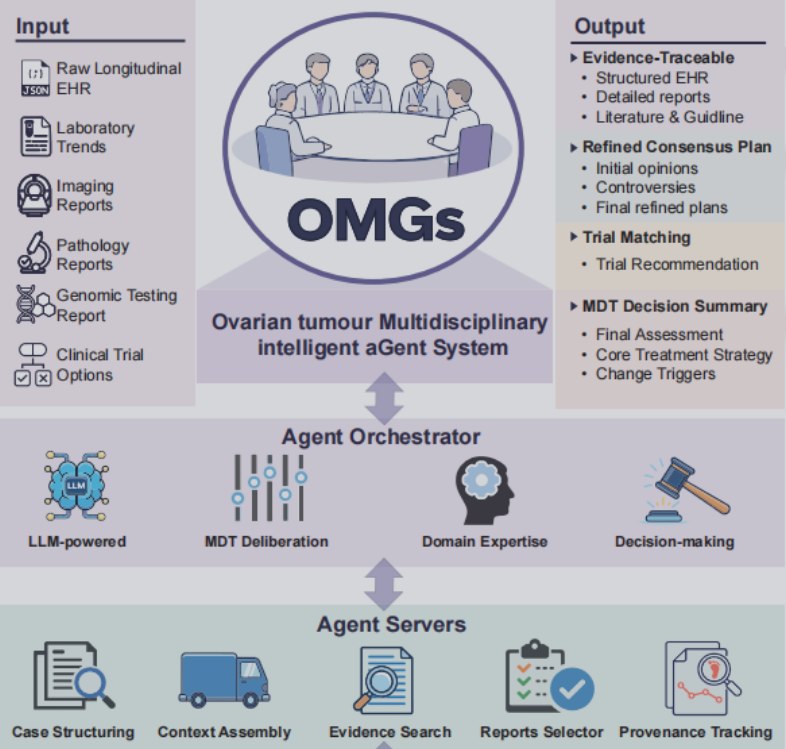
Download PDF 背景现实医学背景 MDT:MDT 的全称是 Multidisciplinary Team,可理解为多学科团队协作。团队通常包含外科、肿瘤内科、放疗科、影像科、病理科等医生,有时护士、营养师、心理医生也会加入。大家围坐讨论,避免单一科室决策的局限。 卵巢肿瘤的管理越来越依赖于多学科肿瘤委员会MDT的讨论,以应对需要手术、肿瘤内科、影像、病理、分子检测多学科协同治疗。并且此病症有三个特别棘手的特征:晚期诊断、显著的肿瘤异质性、频繁复发。这些特征意味着患者在整个病程里需要反复面对高风险决策。然而全球大多数患者缺乏及时的专家共识,尤其在资源受限的中心。MDT 资源稀缺甚至完全不可用。 于是,本文提出了OMGs(卵巢肿瘤多学科智能体系统),多智能体AI框架,通过协调多学科的证据,用于给出透明依据的MDT式的建议 AI决策支持的四个挑战 In this context, single-agent large language model (LLM) assistants may be insufficient to ensure that recommendati...



/cover.jpg)